


TMNZ stepping up for Leukaemia & Blood Cancer New Zealand

TMNZ staff are raising money for Leukaemia & Blood Cancer New Zealand by racing up the tallest building in the Southern Hemisphere next month.
Grace Evetts, Mara Fisher, Neil Bhattacharya, Jatin Sharma and Lee Stace – collectively known as the ‘TMNZ Fast Five’ – are participating in this year’s Step Up Sky Tower Stair Challenge on 9 August.
They will join other teams from across New Zealand in racing up the 1103-step Auckland Sky Tower . The structure stands an impressive 328m and is 51 floors.
The money TMNZ raises will help Leukaemia & Blood Cancer New Zealand pay for patient support, research, information and advocacy.

About Leukaemia & Blood Cancer New Zealand
Leukaemia & Blood Cancer New Zealand is the national charity that supports patients and their families.
Blood cancers combined are the fifth most common form of cancer in New Zealand. An estimated 21,000 people live with blood cancer or a related condition.
In fact, six children and adults in New Zealand are diagnosed with a blood cancer like leukaemia, lymphoma and myeloma every day.
Despite doing such fantastic work, Leukaemia & Blood Cancer New Zealand receives no government funding.
The Step Up Sky Tower Stair Challenge is a key fundraiser for this organisation. That's why TMNZ staff are exercising their social responsibility by competing in this event.
How you can help
If you wish to sponsor one of the individual team members or donate directly to the team, you can do so here.
The TMNZ Fast Five are training hard to ensure they are fit and strong enough to tackle the Step Up Sky Tower Stair Challenge.
However, they cannot raise much-needed funds for Leukaemia & Blood Cancer New Zealand without the generosity of others.
They will appreciate any donations, so please give whatever you can.
And remember, anyone who makes a donation of $5 or more is eligible to receive a 33.33 percent tax credit or rebate from IRD.


Tax Policy Scholarship Competition finalists
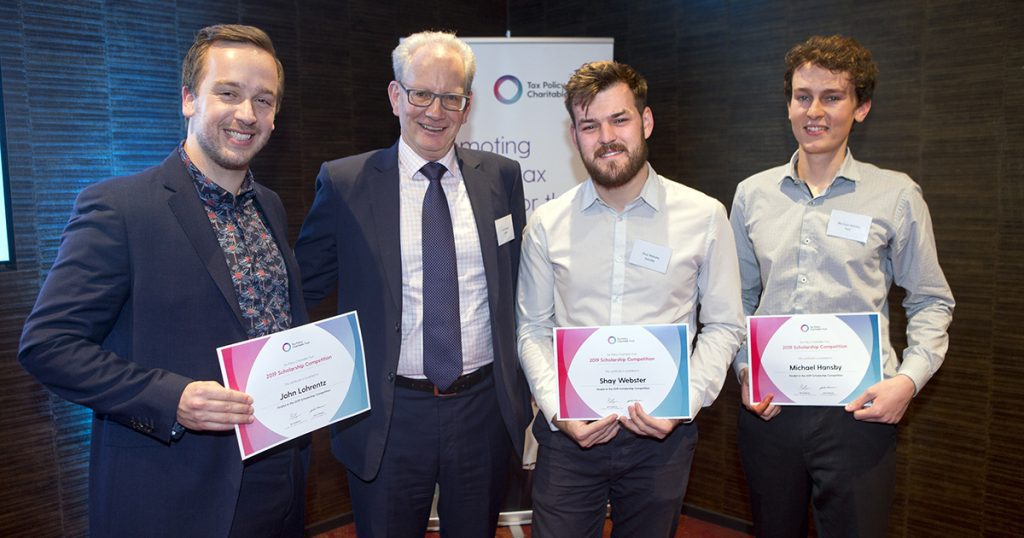
A negative income tax coupled with a flat tax rate for individuals and the creation of a trusted taxpayer regime.
These are among the ideas judges will hear as part of the Tax Policy Scholarship Competition.
A tax on biogenic methane emissions and freshwater as well as reforming the R&D tax credit regime are the others options on the table.
Spark’s Nigel Jemson, and the Deloitte duo of John Lohrentz and Shay Webster are this year’s finalists.
They are vying to win $10,000 prize money.
The three finalists’ proposals are an interesting mix of environmental, social assistance and behavioural messages, says Tax Policy Scholarship Competition judge and Tax Policy Charitable Trust chair John Shewan.
The ideas of the quartet
Jemson is pushing for the creation of a trusted taxpayer regime.
This will see businesses receive a 10 percent discounted tax rate by opting to regularly report financial information to IRD.
Anyone part of the scheme for three years or more will also have their annual tax return requirement removed.
A small business would be eligible for the scheme if they are using the accounting income method to pay provisional tax and operating a “predominantly cash-free” business.
As for Webster, he favours using tax to create a broad, universal welfare system to tackle inequality, reduce the cost of welfare and stimulate the economy.
He proposes doing this by implementing a negative income tax combined with a flat rate of 33 percent for individuals.
Under this, those earning less than $31,500 will receive a tax credit or a weekly or fortnightly cash payment from the Government.
Meanwhile, Lohrentz supports a progressive tax on biogenic methane emissions in the agriculture sector.
Revenue from the tax would go back into agricultural. That would be in the form of:
- A fund to grant money to those changing land use, planting trees, retraining or implementing more efficient practices and technology.
- An R&D tax credit exclusively for climate change-orientated R&D in the agriculture sector.
Not only that, but he also promotes a 40 percent R&D tax credit. This would be for taxpayers undertaking a core R&D activity that fosters ‘natural capital’ in New Zealand’s agriculture sector.
The next stage of the Tax Policy Scholarship Competition
The finalist will present to the judges in Wellington in November.
Shewan says their proposals have the potential to make a difference to New Zealand society.
Still, the judges will be considering other factors when making their final assessment. That’s because these ideas may also place additional pressure on the tax system or have unintentional consequences.
“The judging panel will be looking closely at issues such as complexity, economic impact, the potential for distortions and technical feasibility in judging the final submissions,” says Shewan.
As well as Shewan, the other judges on the panel are former Reserve Bank of New Zealand governor Alan Bollard, tax barrister David McLay, former Bell Gully tax partner Joanne Hodge and former IRD deputy commissioner Robin Oliver.
While the winner will collect $10,000, the runner-up will receive $4000 and the other finalist $1000.
Tax Policy Scholarship Competition background
Every two years, the Tax Policy Charitable Trust invites young tax professionals with an interest in tax policy to make a submission.
Submissions for the Tax Policy Scholarship Competition must outline a significant reform to the New Zealand tax system.
It is open to those under the age of 35 working (or eligible to work) in New Zealand. Those in the public and private sector or academia can enter.
There were 14 entries this year.
“Several submissions focused on the use of tax to achieve social and environmental outcomes, and to incentivise taxpayers to behave in particular ways,” says Shewan.
This is the third Tax Policy Scholarship Competition.
Previous winners include Matt Woolley and Talia Smart (both 2017) and Caleb McConnell (2015).

About the Tax Policy Charitable Trust
Tax Management NZ founder Ian Kuperus is responsible for creating the Tax Policy Charitable Trust.
His aim is to support the continuation of leading tax policy research and thinking and inspire future tax policy leaders.
In addition to the Tax Policy Scholarship Competition, the trust also sponsors the visit of a leading tax expert to New Zealand.
This is to ensure New Zealand benefits from the best tax thinking from overseas.
Last year, it held an event with the Tax Working Group members after the release of their draft report.

TMNZ's provisional tax calculator
At TMNZ, we're 100% invested in simplifying provisional tax for New Zealand businesses. Our provisional tax calculator helps you by removing the time and strain of calculating your provisional tax payments.
- The tax calculator tool helps calculate provisional and terminal tax liabilities.
- We help you choose the best time to file. Toggle potential tax filing dates to see if there's an impact on your tax bill.
- One step payment arrangements. Once you know the liability, you can set up a payment plan with Flexitax.
The information you need to use the provisional tax calculator
All that you require is:
- Your IRD number
- Your residual income tax (RIT) for your last two tax years, the dates the income tax returns for those years were filed, and the expected/final RIT for the current year.
How to calculate your payments
To use our provisional tax calculator, log in to your TMNZ dashboard.
If you've not already done so, you can register for free.